Hypothetical ligands have been included in the model to increase its applicability.
Ligand A and Ligand B are examples of ligands that have marked differences in affinities
(-log Ki values) for receptor subtypes (not evident with established ligands).
You may nominate affinities (-log Ki values) for Ligands C and D.
Competing Ligand
-log Ki Value
M1
M2
M3
M4
M5
Established
Atropine
9.0
8.8
9.3
8.9
9.2
Pirenzepine
8.2
6.5
6.9
7.4
7.2
Methoctramine
6.7
7.7
6.0
7.0
6.3
Darifenacin
7.8
7.0
8.8
7.7
8.0
MT-3
6.7
5.9
6.0
8.1
6.0
S-Secoverine
8.0
7.9
7.7
7.7
6.5
Solifenacin
7.6
6.8
7.9
7.0
7.5
DAU-5884
8.9
7.1
8.9
8.5
8.1
Hypothetical
Ligand A
9.0
9.0
6.0
6.0
2.0
Ligand B
8.0
5.0
8.0
5.0
8.0
Ligand C
*
*
*
*
*
Ligand D
*
*
*
*
*
Assumptions of the Model
All of the usual assumptions associated with Law of Mass Action that
typically
describe drug binding to receptors
All receptors are equally accessible to ligands.
All receptors are either free or bound to ligand - i.e. the model ignores any states of
partial binding.
Neither ligand nor receptor are altered by binding.
Binding is reversible.
Assumptions associated with competition binding studies
Only a small fraction of both the labelled and unlabelled ligands has bound, so the free
concentration is virtually the same as the added concentration.
There is no co-operativity – binding to one binding site does not alter affinity at
another
site.
The experiment has reached equilibrium.
Binding is reversible and follows the law of mass action.
Other model-specific assumptions
Analysis is conducted using % Specific Binding (no non-specific binding)
[3H-QNB] used in studies was << KA of 3H-QNB for
receptors
present, i.e. Cheng-Prusoff equation reduces to IC50 ≅ Ki for
all
competing ligands.
SPIKESmate
an educational application to boost proficiency in interpreting competition binding data
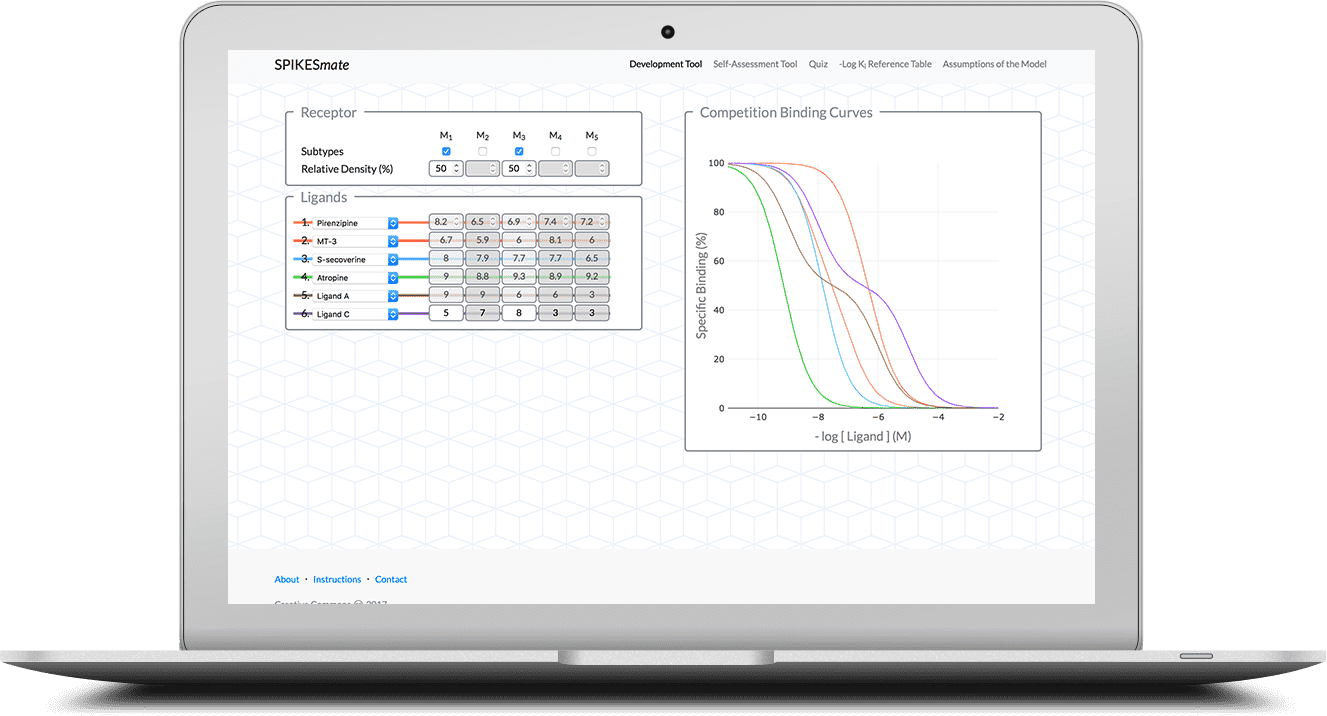
The Development Tool is used to visualise how changes in the characteristics of drugs and receptors, such as affinity, can affect drug binding to receptors.
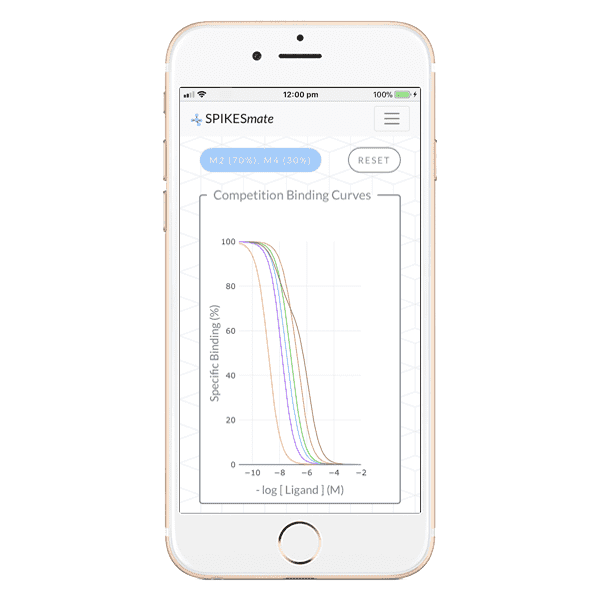
The Self-Assessment Tool is used to develop competencies in the visual interpretation of drug receptor binding data, via the generation and analysis of the theoretical drug binding data.
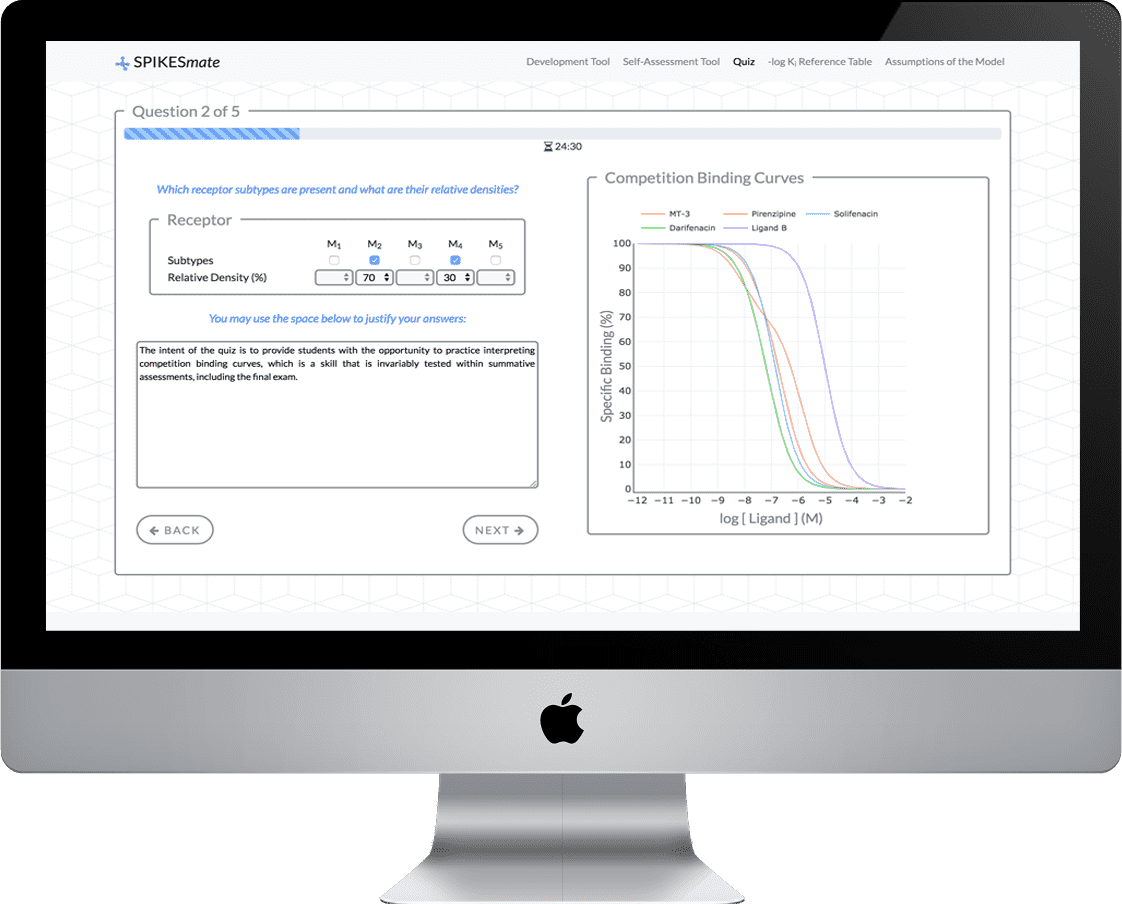
The Quiz Tool is an extension of the self-assessment tool, to develop competencies in the visual interpretation of drug receptor binding data, however allows users to test themselves under test like conditions - being timed and scored.